Most drivers only think about their mechanic when something goes wrong – a strange noise from under the hood, a warning light on the dash, or that unmistakable smell of burning oil. But behind the scenes, the way mechanics actually find and fix problems has changed dramatically over the past couple of decades. What used to be a process of guesswork, dismantling, and trial and error is now a far more precise science, blending old-school mechanical knowledge with new diagnostic technology.
The Old Way: Take It Apart and Look
For most of automotive history, if a mechanic suspected a problem inside an engine — a cracked cylinder wall, a burnt valve, debris in a fuel line — there was really only one way to confirm it: take the part apart. This meant pulling the intake manifold, removing the cylinder head, or disassembling entire sections of the engine just to get a visual on a component that might turn out to be perfectly fine.
This approach worked, but it was slow, labor-intensive, and expensive. Every hour spent disassembling and reassembling an engine was an hour billed to the customer, and there was always a risk of introducing new problems during the process – a gasket that doesn’t reseat quite right, a bolt torqued incorrectly, or a seal that gets nicked during removal. For a shop trying to run efficiently, and for a customer trying to avoid an inflated repair bill, this was never an ideal solution.
The Modern Toolkit
Today’s mechanics rely on a combination of computer diagnostics and physical inspection tools that let them see far more without touching a wrench. OBD-II scanners read fault codes generated by a car’s onboard computer, narrowing down a problem to a specific system or sensor before any parts are removed. Multimeters test electrical circuits. Compression testers and leak-down testers assess engine health without opening things up completely.
But one of the most useful additions to a mechanic’s kit over the last several years has been the inspection camera – more commonly known as a borescope. In simple terms, it’s a small camera probe attached to a flexible or rigid cable, connected to a screen that shows a live video feed as the probe is threaded into tight or hidden spaces. Some models are basic, offering just a light and a fixed-view lens, while others include features like image capture, video recording, and probes that can be steered around bends once they’re inside a cavity. If you’re not familiar with the tool, there are a couple of things to know to pick the right borescope for the job – probe diameter, cable length, articulation, and image quality all vary quite a bit between models, and the right combination really depends on what you’re trying to inspect.
Why Borescopes Matter for Engine Work
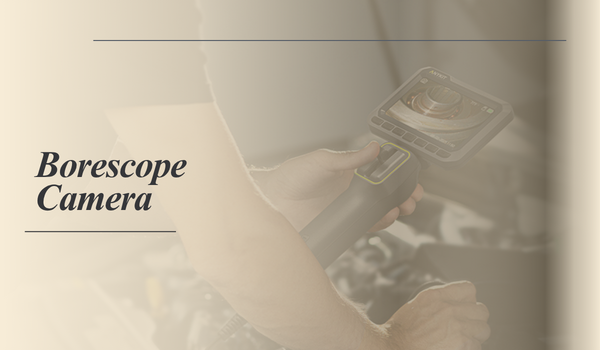
A borescope is, at its core, a small camera mounted on a flexible or rigid cable, connected to a screen that displays a live video feed. The probe can be threaded into places a mechanic’s eyes and hands simply can’t reach – down a spark plug hole to inspect piston crowns and cylinder walls, into an intake manifold to check for carbon buildup, or along a fuel line to spot cracks and debris. What once required pulling apart half an engine can now often be confirmed or ruled out in a matter of minutes.
This matters most when a mechanic is trying to diagnose something ambiguous. Say a customer complains about a knocking sound and reduced power. The symptoms could point to several different causes – worn piston rings, a damaged valve, a bent connecting rod, or something far less serious like a loose heat shield. Instead of guessing and disassembling on a hunch, a mechanic can feed a borescope probe into the cylinder through the spark plug hole and get a direct visual on the piston and cylinder wall condition. If everything looks clean and undamaged, the search moves elsewhere, and the customer avoids paying for unnecessary labor.
Articulating borescopes take this a step further. Unlike a basic rigid or semi-rigid probe, an articulating model lets the mechanic steer the tip of the camera around corners and into awkward angles – useful when a component of interest isn’t sitting in a straight line from the entry point. It’s remarkable just how much articulating borescope cameras can see in engine bays packed tightly with hoses, wiring, and components, where that extra control can be the difference between getting a clear look at a suspect part and missing it entirely.
Beyond the Engine
Borescopes aren’t limited to engine internals. Mechanics use them to inspect exhaust systems for cracks and corrosion, check the inside of fuel tanks, look behind dashboards for wiring issues, and even peer into transmission housings during diagnostic work. For anyone doing their own maintenance at home, the same tool is handy for checking things like brake line routing behind body panels or confirming whether a rattling sound is coming from a loose heat shield rather than something more serious.
The appeal is the same whether you’re a professional or a hobbyist: a clear picture of what’s actually happening inside a component, without the time, cost, and risk of full disassembly. For a shop, that translates into faster, more accurate diagnoses and lower labor costs passed on to the customer. For a DIY mechanic working in a home garage, it means fewer unnecessary parts purchases based on guesswork.
Skill Still Matters
None of this technology replaces the fundamental knowledge a good mechanic brings to the table. A borescope can show you a cracked piston ring land or a scored cylinder wall, but it takes experience to recognize what’s normal wear versus what’s a genuine problem, and to understand how that damage likely occurred in the first place. The tools have gotten better, but diagnosing a car well is still built on understanding how an engine, transmission, and electrical system actually work together – the camera just gives that knowledge somewhere useful to look.
That combination – trained judgment paired with better visibility into places that were once inaccessible without teardown – is really what has changed most about car repair in recent years. The engines themselves haven’t gotten simpler, but the process of figuring out what’s wrong with them has gotten a lot smarter.